Healthy Schools Peace Corps Volunteer in Guatemala since February 2013
Showing posts with label Guatemalan celebrations. Show all posts

Sunday, November 1, 2015

Happy All Saints Day Guate-Style

The two years I was in Guatemala for All Saints Day (November 1) were two of my favorite and most memorable days. The giant kite festival and drunken horse races* were both events were like nothing I had ever experienced before. *The men riding the horses were drunk not the horses

The first year I went to the giant kite festival in Sumpongo, Sacatepéquez. They were GIANT - multiple stories tall and made completely out of tissue paper! Check out my blog post on the giant kite festival!
This wasn't even close to the tallest kite there
Such beautiful detail!

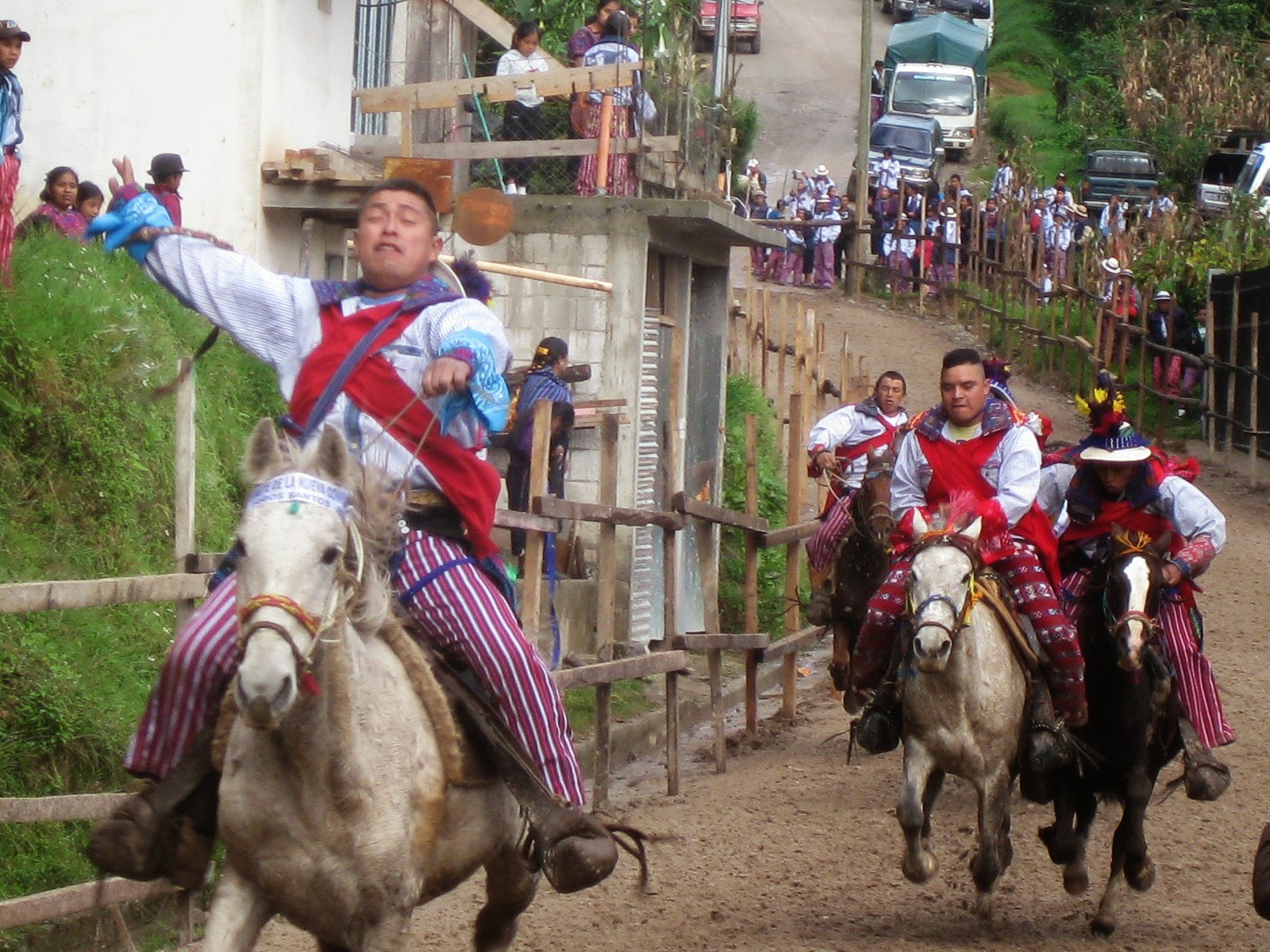
The second year I experienced the drunken horse races (the men were drunk not the horses) in Todos Santos, Huehuetenango. Check out my blog post on the drunken horse races!
They were literally all completely drunk

Oh and I can't forget the traditional All Saints Day food, Fiambre

Monday, March 2, 2015

Fair in my Town

This post is a little late. The fair in my town is August 20-28. Ferria (fair) in Guatemala is special. I think it speaks to the vibrant Guatemalan culture. In the U.S.A., at least in New England where I am from, if you want a town fair your options are limited. There are probably only a couple a year and they aren't all that close by. The vast majority of even the smallest towns here in Guatemala all have a patron saint and put on a week-long celebration in their honor. I have been to fairs in a number of towns and there are always: parades, cultural dances, marimba performances, rides, games, and lots of street food. It's a fun time. 

Selling sweets: the coconut cake which is more like dried and compressed shredded coconut is my favorite
(white and yellow and pink above)
The white balls are tasteless homemade gum

The centerpiece of the fairs are always the parade. My town is right on the Inter-American Highway (CA-1). This highway connects North, Central, and South America. The Guinness Book of World Records claims that the Pan-American Highway is the world's longest motorable road. It's a pretty big deal and I live a two minute walk from it. It is part of the reason why there is such good transportation in my site. That being said it is also a drug route to Mexico and the U.S.A., but I haven't run into any issues with that luckily. I would however recommend flying if you are taking a trip from the U.S.A. to Guatemala. ANYWAY, for our fair they shut down this important road for a couple of hours for the parade to travel along it and into the center of town.

These parades consist mainly of local school children. Most schools have their band play and the rest of the students march along. This is a costly event and takes up many many many school hours for practicing. Another staple in the parades are the floats. Each school basically decorates a pick-up truck for the winner of their beauty pageant. 

In my town of around 3,350 people (2012 health center census) there were three different ferris wheels. Fun fact that I learned about ferris wheels while I was in Guatemala: the first ferris wheel was shown at the world's fair in Chicago in 1893. That is why in Spanish they call ferris wheels "la rueda de Chicago" the wheel of Chicago. One thing about the ferris wheels here are that they go super fast! I think they hook special motors up to them because they go faster than any ferris wheel that I have ever been on. 

They are somehow related to my host family.
They stopped walking in the parade so that I could take a picture.
Beauty pageant winners from one of my schools on their float
Dancers. This is the only time knees have been shown in my town
Some students I know riding the smaller (hand powered) ferris wheel
Enjoying my 1Q ($0.14) bag of cotton candy

Tuesday, February 17, 2015

Happy Carnival (Fat Tuesday) from Guatemala!

Confetti everywhere
Carnival isn't quite celebrated here like it is in Brazil with the sparkling bikinis, elaborate headdresses, and parades. The culture here is a little too conservative for that (the bikini part). This has really changed me. I no longer feel comfortable wearing shorts even in touristy areas such as Antigua or Panajachel and would never think of wearing them in Xela or close to my site.

Guatemala does however have a more vibrant celebration of Carnival than I have ever seen in the U.S.A., especially in the elementary schools. From what I have seen it is counted as an in-school holiday. Kids and teachers come in, but there aren't classes. The tradition here is to wear masks and throw confetti and colored hallowed-out egg shells at one another until everyone is thoroughly coated.


Above is my new sitemate. He will be continuing the Healthy Schools Project after I leave. Part of my job in my last couple of months is to facilitate his integration into the community and project. When telling him about Carnival I told him that kids throw confetti and gave him two packets of glitter. I thought that the epic confetti/glitter battle that goes on would be better left as a surprise. I was not adequately warned on my first Carnival and showed up without anything to throw back. It's a shame you can't really see it in this picture, but besides the confetti on his shirt he is covered in glitter. 

I did not take other pictures today, but HERE is the link to my blog post about Carnival in a school last year.

Monday, February 2, 2015

A Guatemalan "Baby Shower"

I'm not kidding - here in Guatemala they call it "un baby shower." Not "un" as in not "un" as in one in Spanish. It was a nice event. It seemed to be family, friends, and me. The expectant mother is the daughter of the principle of the school in my town. I had never met her before, but my host family brought me along anyway. I was the only female over the age of 10 who was wearing pants instead of the traditional mayan skirts and tops. As with many Guatemalan events that I have been to there were a lot of dínamicas (ice breakers). In fact that was most of the baby shower. Below are some pictures of the more entertaining activities.

Feeding a friend with a baby bottle. It was a competition to see who could drink the whole bottle the fastest. Maybe they were just uncomfortable or embarrassed, but they didn't seem to particularly enjoy whatever was in the bottle.


Measuring the mother-to-be's belly with toilet paper. A woman went around the room and we ripped off as much toilet paper as we thought would wrap around her stomach. For each square of toilet paper that you got wrong (either too big or too small) you had to deposit 25 centavos ($0.3) into the baby fund. I was 5 squares off so I put in the 1.25 Quetzales ($0.16). It didn't generate a lot of money, but I thought that it was a nice idea and I hope they put it to good use. 


Party favors. Each person got this party favor which had little hard candies in the cup on the back. I found it interesting how these babies look much more like gringos than their baby is going to. Maybe it was just had to find a darker colored foam paper. 


Guess what's in the diaper. A couple was blindfolded and they had to figure out what they were holding. It was a diaper with chocolate in it, but it looked like something else that you would more commonly find in a diaper so they had shocked looks on their faces when they took off their blindfolds.


Pregnant grandfathers-to-be. There weren't men at the baby shower other than the father-to-be, his father, and the father of the mother-to-be. In this activity they made a ball of cloth and wrapped it up in another cloth and tied it to the Grandfathers-to-be to stimulate pregnant bellies. They then had to tie and untie their shoes. The chubbier of the two had a harder time as he had an extra stomach on top of his own. Of course there were many jokes about him being further along in his pregnancy. 


Practice bathing and clothing a baby. The mother and father to-be had to pretend to bathe and clothe a doll.


There were also a couple other activities. Everyone gave one piece of advice to the couple (I recommended that they read to their baby and everyone just kind of looked at me like I was crazy). Everyone suggested a name for the baby. Then the worst of the activities that got me a couple of times. If you crossed your legs (fully or even only your ankles) they tied one of the fake baby bellies around you and you had to wear it until you saw someone else with their legs crossed. The whole event took about three hours and it was all followed by a light snack.

As I mentioned in the beginning of this post I had never met the mother-to-be and had only worked briefly with her father, yet my host family brought me along anyway. They have invited me to a number of weddings (here are my blogs on wedding number one, two, and three) where I similarly did not know the people getting married. I am so glad that they did and that they are so open in this respect, but it makes me think about if my own family had a long term foreign exchange student, or someone similar, if we would invite them to all of our family and other events. Maybe it helps that by going to these events I didn't screw up any pre-made seating plans or plate count for food. I think that this relative informality compared to what I have experienced in the U.S. is partially the reason, but I think that I also lucked out being placed in Guatemala in a family-oriented culture and with this host family.

Monday, December 15, 2014

Laguna and Volcano Chikabal in San Martin Sacatepequez, Quetzaltenango


Laguna Chikabal is a sacred lake that formed in the crater of a volcano. It is a natural and cultural monument here in Guatemala. It is extremely well taken care of and respected. The story goes that there was a lake partway up on the side of the volcano, but people didn't take care of it and it became polluted. One day the lake was gone. It had been moved up to the crater of the volcano. Now it is considered a sacred spot. I wish that this could happen again in Guatemala. So many of the lakes are disgustingly polluted. I'm not sure how serious this is, but upon starting up the hike there is a sign that says: "before walking up to the laguna please ask permission from the creator of the Earth." No one is allowed to swim in the lake and the legend goes that if you do you will get sucked into a spiraling vortex to hell. (I elaborated the spiral vortex to hell part, but it is something similar).  

It is beautiful. From the town below (San Martin, about an hour outside of the center of Xela) visitors can call a pickup truck to take them to laguna seca (dry lake) a flat resting area where the lake used to be. From there it is about an hour's steep hike up to the lookout point (mirador on the map). To get from there down to the lake you can either hike down or take the 580 stairs down. 

Clouds covering the lake
Clear view from the lookout point
There are 580 stairs leading down to the lake
Cool tree that is in and out of the water - we were extra careful not to fall in
so that we didn't get sucked into the spiral vortex to hell
 

The laguna is a special place for Mayan ceremonies. Sometimes walking around the perimeter of the water you will see leftover flowers and candles or even a ceremony in progress.

Mayan ceremony in progress

My good friend and fellow PCV wrote a nice article about the lake. Click here to read the article. 

Tuesday, November 11, 2014

Drunk Horse Races in Todos Santos, Huehuetenango for All Saints Day

November 1st is a big holiday in Guatemala. It is called Día de Todos Santos (All Saints Day) and it is celebrated by eating Fiambre, visiting cemeteries and remembering deceased relatives. Last year I went to the giant kite festival in Sumpongo, Sacatepéquez. This year I traveled to the little village of Todos Santos Cuchumatán in the department of Huehuetenango. They are known for their traditional traje (pronounced traw-hey) that both men and women still wear and their unique All Saints Day tradition: drunk horse races. To be clear the men riding the horses are drunk, not the horses themselves. 

The idea is that the men drink the whole night before and then ride the horses the whole next day drunk. The men and horses did rotate throughout the day. I have heard many different "reasons" behind this custom. Besides celebrating All Saints Day the races are to symbolize the beginning of the harvest. In one of the races a couple of chickens are sacrificed by the men by swinging the chickens around by their necks as they ride. 

The whole "race track" was probably only about a quarter mile long. The people who were regulating the races blew their whistles and off the horses went. There would be a short break at the other end, we would hear more whistles and back they would come. I don't think that they picked a winner of the race, we tried speculating on what exactly the men were trying to do and decided on the factors that we would judge them on: fastest time in each race, drunkenness (the more the better), general style points (shouting as they pass by, no hands, etc), amount of time racing, and of course just staying on the horse. We did see three men fall off their horses. We saw all of them get up and walk away, but it all still seemed very dangerous.  

It mainly seemed like general drunken debauchery to me. As a rule of thumb I stay as far away from bolos (drunk men) here in Guatemala as I can. However here the streets were full of them. Drinking and dancing and walking down the streets. If there is an open container law here in Guatemala it certainly isn't enforced.  

To really get a feel for the races check out my short video:


The whole town, event, and people were so colorful and this was so unlike anything that I had ever seen before that I took over 500 photos over the weekend. I tried my best to weed them down a bit. 

"Welcome to the horse races"
There was drinking at all times: both on and off the horse
The little town was so beautiful
I am used to seeing women in traje so it was cool to see all the men wearing it.
They even looked pretty from behind
Young boys in traje típico watching the races
Standing watching on the sidelines we periodically got
hit by flying mud
Traditional male traje jacket. So beautiful.
Drinking everywhere
What a beautiful remote area