Healthy Schools Peace Corps Volunteer in Guatemala since February 2013
Showing posts with label Healthy Schools work. Show all posts

Saturday, August 1, 2015

Planting a New School Garden!

Part of the Healthy Schools Project includes school gardens. The idea is that not only will it teach the kids about gardening, but also so that the vegetables can be used to make the school snack healthier. I don't know about where you went to elementary school, but at mine there was a small garden and there was an after school program called "City Sprouts" where we learned about gardening and made some healthy recipes. I'll be honest I only went to a few days of City Sprouts and remember making Kale soup way before Kale became popular. 

I really liked the school garden part of Healthy Schools mainly because it is so applicable to their lives. In the town that I lived in, and the surrounding area the main industry was agriculture. However, I would guestimate that over 90% of what was produced in this area was corn. Literally there were corn fields and only corn fields everywhere. 
Town center (during our fair) surrounded by corn fields 

To start off with, the patch of land that this school decided to grow its garden on had its problems:
The plot to the left - soapy run-off from the bathroom to the right
Burning the school's trash
The school's kitchen billowing smoke

But all that aside the kids, teachers, and I got to work.
Little kids are usually deemed responsible enough to work with machetes
Me getting down and dirty (the kids really did most of the work)
Resourceful
The teachers and I

While the garden plan could use some more work, they did get an ok crop of radishes. It was a start and hopefully next year they will grow their garden so that the vegetables can be used in the school snack. :)

And one picture of the little ones because they are just so stinking cute. This is in the school "playground" aka the dirt field in front of the school.

Thursday, February 26, 2015

Learning How to Assemble Toilets...Something I Wasn't Expecting to Learn

I never could have imagined all of the things that I would do or learn while a Peace Corps Volunteer. I am constantly surprised. I am lucky enough to have gone to a number of trainings put on by both the Peace Corps and local NGOs. One such training was put on by Agua Para La Salud (Water for Health) in conjunction with the Peace Corps. In this training we brought counterparts and learned to assemble, disassemble, and unclog toilets.

I'm glad that I learned how to do it.... but don't call me if you need a plumber.

Screwing the tank in. (p.s. family and friends I do not want
to see this picture everywhere, thank you very much!)

Here is the list of trainings I have received to date: intensive Spanish language instruction, Mayan language instruction, cross-cultural training in non-formal education, project design and management, situation management, community analysis, personal safely, preventative health, HIV/Advanced HIV, Gender and Development, improved practices for school gardens, leadership, monitoring, reporting, and evaluation, tools for improving water, improved wood-burning stoves, sanitation and hygiene at schools, education theory, improvement of school gardens and methodologies to improve work with very young adolescents, water sanitation and hygiene, nutrition, food security, and project design and management. The Peace Corps has given me the opportunity to learn a great deal about topics that I never though that I would study and I really appreciate it!

Tuesday, December 30, 2014

Multi-Department Leadership Summer Camp at Laguna Chicabal


The name of the camp was Lideres de mañana - Leaders of tomorrow with the great and fitting quote: "las grandes personas de la historia también fueron niños" "the great people in history were also once children."

Two of my good friends in the Peace Corps took the initiative to put together a huge multi-department leadership summer camp. The camp took place at the beautiful Laguna Chicabal. All volunteers in the Xela/Toto area were invited and each volunteer that participated in the camp brought a Guatemalan work partner and four campers from our sites (two boys and two girls). The camp was four days and three nights. PCVs even took turns patrolling on night duty throughout the night. It was a crazy time but amazingly it all went pretty smoothly. I was exhausted at the end of it all, but I am so glad I participated in it.

Summer camp for kids here in Guatemala is not a thing. Maybe for the affluent in the capital, but out in the rural areas where we all live and work summer is a time for the kids to be at home and probably working. This camp also helped to fill a gap in the educational system. Many girls leave the sixth grade (if they are lucky enough to get to the sixth grade) without knowing what menstruation is or how that relates to their ability to bear children.

Volunteers lead activities on a wide range of topics such as: leadership, the importance of working in a team, a hike to the laguna, self-esteem, nutrition, recycled crafts, decision-making, gender equality, reproductive health, and HIV.  We also did some fun camp activities such as: an ice cream social, movie night, lots of dínamicas and ice breakers, and on the last night we had some fire dancers come in from Xela and put on a show while we roasted marshmallows.

Things that onle seem to happen in Guatemala
Importance of working in a team session
"Peace on Earth, Peace Corps, Guatemala 2014"
Summer camp wouldn't be complete without s'mores

Friday, October 17, 2014

Sociodramas and School Vacation

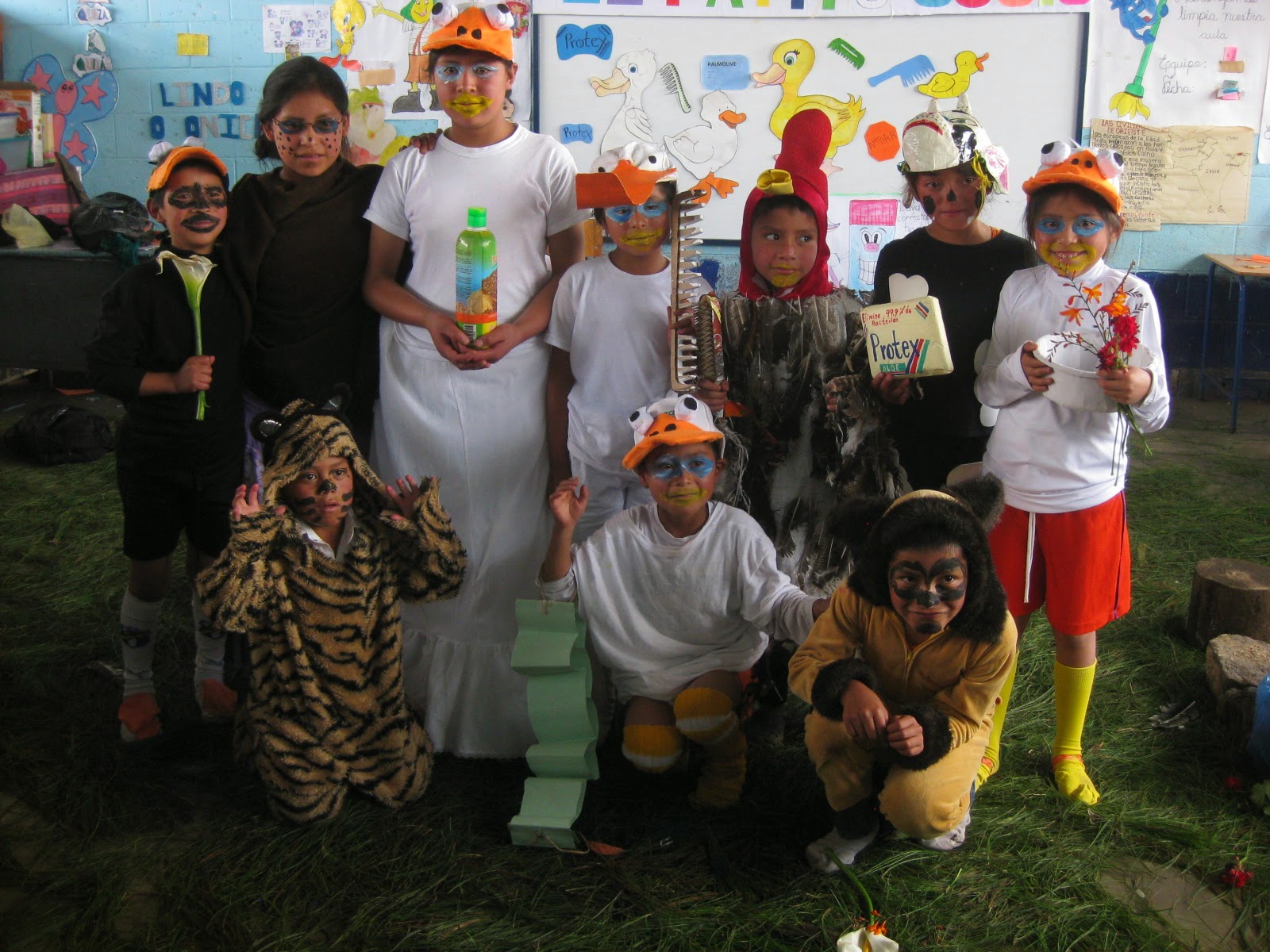
This year the department (like a state) that I live in participated in a Sociodrama health skit fair competition. I worked with one of my schools to prepare a short ten minute health skit. They titled it "El Patito Sucio" (the dirty 1ittle duck). The premise is that the little duck never bathes and as a result of this is too smelly to have friends. She is so dirty that even the dogs don't want to eat her. After some counseling she decides to bathe and then has friends. Simple and oh so cute. Nine schools from all over the department competed at the municipal theater and my school won third place! 

This rooster is quite the little ham. They also used real feathers
that they probably had the kids go out and collect. Talk about dirty.

Warning: this video is entirely in Spanish. It is also entirely adorable.


At the state-level competition one team brought a live chicken to use as a prop (they won first place).


Below are some pictures from other health skits. They covered the themes of: skin infections, bullying, the importance of good nutrition, oral hygiene, the risks of teenage pregnancy, junk food, and alcoholism. I was impressed overall with the level of preparation of each group. Not to mention the elaborate costumes. 

Oral hygiene
Risks of teenage pregnancy
Nutrition
Alcoholism (with the fire, baby, and live chicken)

IT IS NOW SCHOOL VACATION IN GUATEMALA. I am excited to have friends and family come to visit, give an HIV training in the health center, and help out at a leadership camp.

Wednesday, October 8, 2014

HIV Trainings with High School Students

When I first got my nomination for the Peace Corps (the first step post-application) I was told that I would be doing HIV/AIDS work in Sub-Saharan Africa. If you know me or have ever read my blog you will know that this is not where I ended up. Yay Guatemala. So they told me to get some experience somehow working with HIV/AIDS. I volunteered for two organizations in the Boston area. My favorite was working at the Boston Living Center where I helped cook and serve lunch to the HIV+ members once a week (they do lunch every day during the week).

Working in the Healthy Schools Project in primary schools has not given me a lot of opportunities to continue in this line of work, but I have collaborated with a number of volunteers to give HIV lessons to high school students. Because sexual education is deeply lacking here and the subject is taboo, we have to be careful about what we say and what we teach. The community members in my friend's site still talk about this past volunteer who showed porn to students (we are fairly certain that they were just trying to teach a health lesson). So we always get permission beforehand and co-facilitate with Guatemalans so that it isn't just us. We also watch what we say and stress abstinence.  


Each time we give the training a little differently, but we usually show an animated informational video and do a white blood cell activity where you have kids act out a story and portray the immune system, different infections, HIV, the human body, etc. We also do SIDA/NODA (determining what activities/things that can transmit the virus), true/false activities, and so on.  

I have done a number of trainings in different schools, but this was the largest at a private school in Xela. It was an all girls school. It was also the nicest looking school that I have been to in Guatemala. 


This was the only time that I have done a condom demonstration. We passed out cards, each with a step of putting on a condom, and the girls had to put them in order and then demonstrate each step. In the first group we got a couple girls to touch the condom, but in all future groups we did it because they were all too embarrassed.

This was the only group of girls that was willing to touch the condom. 
For some reason this hanging photo creeped me out. 

Wednesday, September 10, 2014

Cooking Classes with Mothers

This past month I completed a cooking class with mothers in two schools. In each school I did the same activity on three days from 9-12 so that I could work with smaller groups. The first day I worked with mothers with children in the 5th and 6th grades, second day with mothers with children in the 4th and 3rd grades, and the third day with mothers with children in the 2nd and 1st grades. Each day about 15-20 mothers showed up. Because large families are common here the majority of the mothers had multiple kids in the school. Therefore, the first day always had the largest turnout and the numbers decreased with each day.

I started out with an hour and a half lesson on nutrition and good kitchen related hygiene. The nutrition part of the class included: the three food groups and "my plate" - which recommends that you divide your plate of food so that 1/2 is covered in protection (fruits and vegetables), 1/4 with body-building (protein), and only 1/4 with energy (carbohydrates). From what I have experienced in this country, meals are not so well balanced. Probably around 3/4 of the plate contains carbohydrates and the other 1/4 with meat or vegetables or more likely beans or an egg. I asked the mothers how many times a week they and their families ate fruits and vegetables. The majority said that they only eat vegetables a couple times a week - once or twice! And not much more frequently for fruits. I was blown away. I don't cook meat here (due to the lack of refrigeration both in my house and with and in the butcher's shops). Therefore, I eat a lot of vegetables (and eggs). I digress. I told them about the recommended 5 servings of fruits and vegetables a day (which they were shocked by). I know that this isn't reasonable to expect them to eat the recommended number of servings, so I asked them to please try and eat at least one serving a day. Poco a poco (bit by bit).

As for hygiene, I talked about kitchen cleanliness (no cats, dogs, pigs, chickens) wandering around the kitchen. Drinking only purified water (boiling the unclean water that comes out of all taps here for at least 5 minutes). Cleaning fruits and vegetables that aren't going to be thoroughly cooked or peeled (by using bleach). Basic hand washing steps (and not drying their hands on their aprons that they wear all day).

Each day I had a teacher from that school co-facilitate with me. I would explain a section in Spanish and then they would explain it in K'iche'. I was really happy with this set-up because I am still working on improving my Spanish and so it was helpful for the people who understand both languages to get the information twice, and obviously much more clear for those who understand very little Spanish.

Me with my posters and a banana. I gave each mother a banana when
they first arrived as a small morning snack.
You can't see it in this photo, but I drew out pictures of different foods and
each participant had to categorize it into energy, body-building, or protection. 
THE THIRD WOMAN FROM THE LEFT IS TAKING NOTES!
YESSSSSSSSSSSSS!
After the lesson we put it all into practice. We made sautéed beet leaves and pasta with tomato sauce that had protemás (a protein enriched meat substitute), carrots, broccoli, and onions. I supplied all of the ingredients and the mothers brought their own cutting boards, knives, and a couple pieces of firewood. In one school we cooked with my little two burner electric stovetop and in the other school we used their wood burning stove. I like telling Guatemalans about eating beet leaves, because the majority of the people have never thought to use them. They go straight to the rabbits or the pigs. Because of this, a lot of people discard the leaves or leave them at the stand at the market. Therefore, sometimes the vendors give them to me for free or I buy a big bag for just a few Quetzales. 

One thing about Guatemalan culture is that it is very rude to not accept food that you are offered or to not eat everything you are given. This has sometimes been difficult for me, but for these classes it worked out excellently! Everyone ate all of the food! "Would you like some more beet leaves?" "Yes." "Perfect." :)

Passing out the pasta and sauce.
I used styrofoam cups and plastic spoons. This was clearly not an
environmentally friendly workshop. Perhaps this will be the next workshop.
Chopping carrots.
I also had a good number of babies and small children
"participate" in the workshop.
Eating beet leaves for the first time.
Stirring up the beet leaves.

The women seemed to enjoy the class and appeared to have learned new information. At the very least that day they learned a little new information and had 1 serving of fruit, 1 of carbohydrates, 1 of protein, and around 2 of vegetables. Which from what I heard is possibly more fruits and vegetables than they normally eat in a week. They all seemed to genuinely like the food. I would call it a great success!