Healthy Schools Peace Corps Volunteer in Guatemala since February 2013

Friday, September 19, 2014

Happy Independence Day, Guatemala! My First Antorcha

September 15 is Guatemala's Independence Day and it is a BIG DEAL. I would say much more so than the 4th of July in the U.S. They should really call it Independence month or at least week because that's how long it is celebrated. Schools get into celebrating it big time and most of them participate in the parade which each little town seems to have. They have costumes and the kids play music like a marching band. I don't think that they have music classes throughout the year, it's just concentrated right before Independence Day.

All week / weekend there were people walking around selling flags, headbands,
whistles. I don't know why he is making that face - a ton of kids bought flags etc.

Many days are taken away from actual classes. Quince (pronounced keen-say - 15 in Spanish) fell on a Monday this year. The previous Monday when I visited schools the day was devoted to practicing music and the dances for the parade. It only got less productive from there. The Friday before I went to an antorcha (torch in Spanish) which is where the schools travel to a special place to go light a torch and the kids run with the torch back to the school. I think this is seen as the official kick-off to quince. If schools choose to travel to a farther location, the kids run the first and last 5-10 minutes.

The school that I went with traveled to the department of Chimaltenango which is about a three hour drive away. The school rented two school buses. It is a school of 500 kids, but only some parents and kids attended (I'm suspecting because it cost a little money to go). I was told by the teacher to get there at 5:45am. I arrived at 6am. The principal of the school along with some other teachers did not show up until 7:00am. I know the hora Chapin (Guatemalan time aka late) but come on I woke up at 5am and an hour is extreme for hora Chapin. But once we all got on the bus (three or more people to a seat obviously) it all went great.


Our first stop (after 30 mins on the side of the road for breakfast) was the Mayan ruins of Iximche (pronounced E-shim-che). I had been here before in training to see a Mayan ceremony


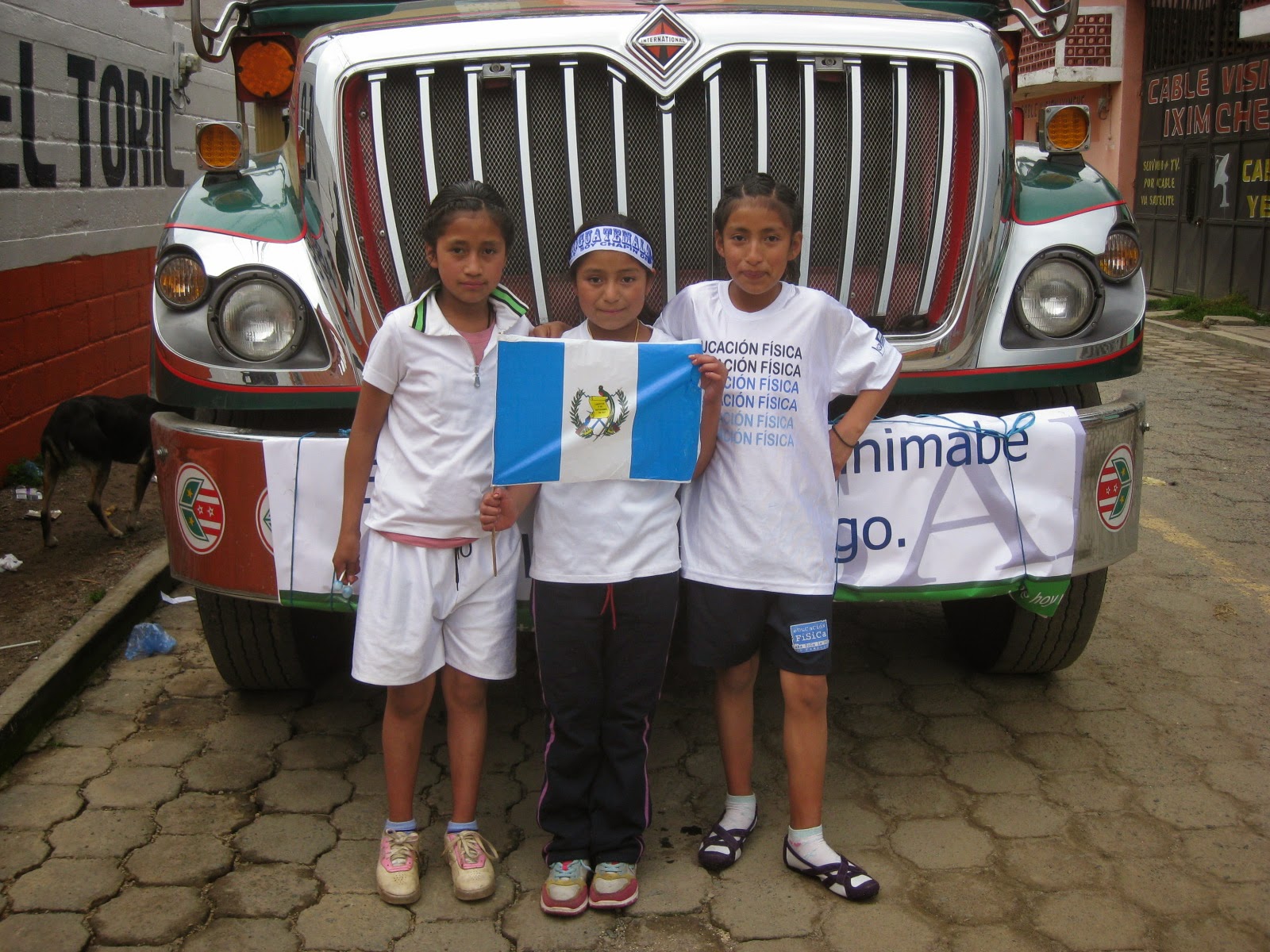
Then we stopped for lunch in Técpan. Most people (including myself) had brought food, so we ate on the bus. After lunch the kids and I did a little photoshoot. There were many more pictures, but here are a few.

This country has 0 rules
Chapinita ((female) little Guatemalan)
Guatemala. I am pure Guatemalan.
The three of them plus another sister and their mother all shared one row of seats on
the bus. For a while on of them slept on the floor with her head on her sister's lap.
All of the kids wore their gym clothes (educación física)

Finally at 3pm it was time for the actual antorcha. We went to the center of town where they had a little podium set up. They said some words and then lit the torch that we had brought (a gasoline-soaked rag in a metal can tied to a stick). The "nina deportes" winner of the sports part of the schools beauty pageant was in charge of running in the front with the flame. From there off we ran - that's right I ran with them! There were no police escorts or blocked off roads. We just took off down the street. We stopped at intersections, but that was the only safety precaution. Oh and that only the bigger kids went - so 4th, 5th and 6th grades. No one was hurt. Sorry in advance for the short video clips. To get them I had to run ahead, take the video, and then catch back up. P.s. to get the full effect you should turn your volume wayyyyyyy up.


Once we got to the turnoff to the road to their school they got out an ran the rest of the way back. This time many more kids got to carry torches. 

Wednesday, September 10, 2014

Cooking Classes with Mothers

This past month I completed a cooking class with mothers in two schools. In each school I did the same activity on three days from 9-12 so that I could work with smaller groups. The first day I worked with mothers with children in the 5th and 6th grades, second day with mothers with children in the 4th and 3rd grades, and the third day with mothers with children in the 2nd and 1st grades. Each day about 15-20 mothers showed up. Because large families are common here the majority of the mothers had multiple kids in the school. Therefore, the first day always had the largest turnout and the numbers decreased with each day.

I started out with an hour and a half lesson on nutrition and good kitchen related hygiene. The nutrition part of the class included: the three food groups and "my plate" - which recommends that you divide your plate of food so that 1/2 is covered in protection (fruits and vegetables), 1/4 with body-building (protein), and only 1/4 with energy (carbohydrates). From what I have experienced in this country, meals are not so well balanced. Probably around 3/4 of the plate contains carbohydrates and the other 1/4 with meat or vegetables or more likely beans or an egg. I asked the mothers how many times a week they and their families ate fruits and vegetables. The majority said that they only eat vegetables a couple times a week - once or twice! And not much more frequently for fruits. I was blown away. I don't cook meat here (due to the lack of refrigeration both in my house and with and in the butcher's shops). Therefore, I eat a lot of vegetables (and eggs). I digress. I told them about the recommended 5 servings of fruits and vegetables a day (which they were shocked by). I know that this isn't reasonable to expect them to eat the recommended number of servings, so I asked them to please try and eat at least one serving a day. Poco a poco (bit by bit).

As for hygiene, I talked about kitchen cleanliness (no cats, dogs, pigs, chickens) wandering around the kitchen. Drinking only purified water (boiling the unclean water that comes out of all taps here for at least 5 minutes). Cleaning fruits and vegetables that aren't going to be thoroughly cooked or peeled (by using bleach). Basic hand washing steps (and not drying their hands on their aprons that they wear all day).

Each day I had a teacher from that school co-facilitate with me. I would explain a section in Spanish and then they would explain it in K'iche'. I was really happy with this set-up because I am still working on improving my Spanish and so it was helpful for the people who understand both languages to get the information twice, and obviously much more clear for those who understand very little Spanish.

Me with my posters and a banana. I gave each mother a banana when
they first arrived as a small morning snack.
You can't see it in this photo, but I drew out pictures of different foods and
each participant had to categorize it into energy, body-building, or protection. 
THE THIRD WOMAN FROM THE LEFT IS TAKING NOTES!
YESSSSSSSSSSSSS!
After the lesson we put it all into practice. We made sautéed beet leaves and pasta with tomato sauce that had protemás (a protein enriched meat substitute), carrots, broccoli, and onions. I supplied all of the ingredients and the mothers brought their own cutting boards, knives, and a couple pieces of firewood. In one school we cooked with my little two burner electric stovetop and in the other school we used their wood burning stove. I like telling Guatemalans about eating beet leaves, because the majority of the people have never thought to use them. They go straight to the rabbits or the pigs. Because of this, a lot of people discard the leaves or leave them at the stand at the market. Therefore, sometimes the vendors give them to me for free or I buy a big bag for just a few Quetzales. 

One thing about Guatemalan culture is that it is very rude to not accept food that you are offered or to not eat everything you are given. This has sometimes been difficult for me, but for these classes it worked out excellently! Everyone ate all of the food! "Would you like some more beet leaves?" "Yes." "Perfect." :)

Passing out the pasta and sauce.
I used styrofoam cups and plastic spoons. This was clearly not an
environmentally friendly workshop. Perhaps this will be the next workshop.
Chopping carrots.
I also had a good number of babies and small children
"participate" in the workshop.
Eating beet leaves for the first time.
Stirring up the beet leaves.

The women seemed to enjoy the class and appeared to have learned new information. At the very least that day they learned a little new information and had 1 serving of fruit, 1 of carbohydrates, 1 of protein, and around 2 of vegetables. Which from what I heard is possibly more fruits and vegetables than they normally eat in a week. They all seemed to genuinely like the food. I would call it a great success!

Friday, September 5, 2014

Oh the Places People Dry Their Clothes

Probably one of my biggest lifestyle adjustments in Guatemala is laundry. My options are hand wash everything in cold water and ripping up my clothes by rubbing it on the rough rock that is the pila (washing station) or take it on an hour bus ride (with one change) into Xela. I will never be bored enough that I have the desire to hand wash all of my clothes. Also, it only costs 15Q to have a good sized bag of laundry machine washed and dried and folded. 

There is no laundromat in my town or much closer then an hour away. As far as I know, no one in my town owns a washing machine. So, every day I see women sitting on the rocks by our river washing clothes. The issue then becomes where to dry all of these clothes. The answer: everywhere. I am constantly surprised by all of the places that I see clothes drying so I thought that I would try to document some of the more creative places.

On the fence in front of the hardware store
Here you can see the heads of women washing clothes

It seems to me that putting your clean clothes/blankets on the ground defeats the purpose, but it's a pretty common drying strategy. 

Tuesday, September 2, 2014

How to Tie a Baby to Your Back Guate-Style


This girl seemed to have some difficulty with her eyes. Otherwise women generally do this without help. It seems amazing to me. They just bend over a little bit, put the baby on their back, trust that is doesn't roll off while they get the first piece of cloth, tie that around them and the baby, tie the second cloth around in the opposite direction (so that it forms an X in front), and voila.

My host sister sharon and cousin Filip
I think this is her sister and not her daughter,
but you can never be sure here
There was a baby under there
This woman was holding TWINS - one in her arms and one on her back

Thursday, August 28, 2014

On (Not) Fitting In

I think this picture pretty accurately describes it.


Imagine that an alien lands in your town and wears similar-ish clothing. That's pretty much how they look at me. I feel like I am being stared at constantly (because I am). The thing is that I basically look like Guatemalans except that I dress differently, I use different styles of bags to carry my things, I have glasses, and I talk differently. I don't stick out here as much as some of my other taller or blonder friends, but I still definitely stick out. 

The 24 Hour Pharmacy in my House

Medicinas Israel: My host Dad's pharmacy


Not to brag or anything, but I'm pretty sure that my host Dad is among the more well-to-do and most influential men in my town. He owns the biggest pharmacy which is right in the center of town and is one of the pastors at the huge Evangelical church. I'm pretty sure he would be considered middle class in America, but not in this tiny town. Anyway, he also has a small pharmacy in the house for after-hours needs. Sometimes after everyone else has gone to bed (around 10pm) there is knocking on our front gate until someone in my host family goes to see what they need and gets the medicine.

Fun fact: In Guatemala you don't really need to know any medicine or have any kind of degree to own a pharmacy. I'm pretty sure my host Dad only graduated from the sixth grade. As my family and friends will tell you, this is handy if you are traveling to Guatemala and have forgotten some medicine and/or your prescription. Just ask one of the many pharmacies and more likely then not they will have it. Just give them the cash and you are all set.

Saturday, August 23, 2014

The Glass Factory in Cantel, Quetzaltenango

I (only) have seven months left in my Peace Corps service so I am starting to feel the pressure to cross things off of my Guatemala bucket list. I think I've been good at this, but I really want to get out and see things. So my newest "check" on the list is the glass factory that is just a short 20 minute camioneta ride outside of the center of Xela. I'm really glad that I went! It's just a small store with glass cups, wine glasses, vases, etc. and if you are lucky you are there while the men are working in the back. My video (below) will give you a good ideas of this small no-frills workshop. 


One thing that I enjoyed was the fact that the men working were so casual about their work. They were wearing t-shirts or long-sleeve shirts and no eye protection or gloves. We just wandered back there, walked right up to one of the workstations (huge barrel of water) and started talking to one of the men and watching him work. We didn't have to wear a protective suit, sign a waiver, wear protection, nothing. I agree that some safety rules and regulations can be a good thing, but I feel like in the states this is often taken to the extreme (I.e. caution: this beverage that you are about to enjoy is extremely hot. Duh I ordered a hot beverage.) 

Recycled glass

I got to try glass blowing! It wasn't something they advertised, we just asked the guy if we could try it. It was awesome. I believe I only got a couple words of instruction: blow slowly and rotate the metal rod. I watched 0 safety videos. Used 0 protection. And guess what - I was completely fine and I made a perfect little glass ball!


Cooperativa Integral de Producción Artesanal de Vidrio Cantel, R. L.
Km. 217.5 Carretera al Pacifico
Pasac II, Cantel, Quetzalenango
Guatemala, C.A.

Monday, August 18, 2014

My New Smoothie Recipe Courtesy of the JICA Volunteer

I think that I have written about Minako, the volunteer from Japan. She lives in the same house that I do and also works in the schools. JICA (Japanese International Cooperation Agency) is basically the Japanese version of Peace Corps. Minako is awesome and is a nutritionist. I have enjoyed collaborating with her. She worked on creating a recipe book to pass out to the local health centers and schools. As I was looking through the book I found a recipe that intrigued me: a banana beet smoothie.

Ingredients:
Bananas
Beets
Milk

Directions:
Cook the beets in a little water until they are soft (I like to do this the day before or make extra)
When the beets are cool, combine in equal quantity with bananas
Add milk until it is the desired consistency
Blend well
Voila!

I like the color. If you aren't the biggest beet-lover you might want to add more banana than beets because the beet flavor is strong. The recipe calls for sugar as well, but I think that the bananas give it enough sweetness.

 Peace Corps is all about goals 1, 2, and 3.
Goal 1: To help the people of interested countries meet their needs for trained men and woman.
Goal 2: To help promote a better understanding of Americans on the part of peoples served.
Goal 3: To help promote a better understanding of other peoples on the part of Americans.

While Minako isn't Guatemalan, I feel that teaching her what a "selfie" is counts as good goal 2 work :)

Minako and I with our smoothies

Wednesday, August 13, 2014

Hiking Volcano Acatenango

The group triumphantly at the top in the middle of the crater

I hiked a second Volcano in Guatemala! It was hard! A group of PCVs and I arranged the trip through O.X. Tours (located in Antigua). Volcán Acatenango is only about an hours drive away from the center of Antigua. The whole trip too 12 hours. We left at 5am, got to the trail-head at 6am, started hiking and with only minimal breaks arrived at the summit at 11:30am. We had lunch in the crater at 13,000ft, left at 1pm, got back to the vans at 4pm, and were back in the hostel in Antigua exhausted and covered in dirt by 5pm. I was asleep as soon as I rehydrated, took a much needed shower, and had a good dinner.

In the hike we ascended 6,000ft over roughly four miles through four different temperate zones (high farmland, cloud forest, high-alpine forest, and volcanic) and returned the same way. The tour company had warned us that the climb is steep and to prepare ourselves mentally for a very physically demanding hike (especially the part they affectionately call purgatory which is the last bit before arriving at the top).

It was really cloudy by the time we got up there, but there was still a great view of Volcán de Fuego (Volcano of Fire) that seemed surprisingly close by. Fuego is an active Volcano and while we were there coughed up huge plumes of smoke. The last time Acatenango erupted was in 1972.

Some of my crazy friends completed the O.X. challenge
they ran around the perimeter of the crater
I like being able to look down upon the clouds

I almost felt like the walk down was harder. Although it probably had something to do with the fact that by that
point we had already hiked 5 hours up 5,000ft

I would never do it again, but I'm glad that I did it.

Monday, August 11, 2014

Zaculeu: The Mayan Ruins in Huehuetenango

I went with my host family to Huehuetenango one Sunday for an Evangelical baptism that my host Dad was (officiating?) the pastor at. After the baptism we went to Zaculeu the Mayan ruins. They were much smaller than the more famous ruins in Tikal, but I still thought they were awesome. Also, I guess because they aren't as well known the security was much more relaxed and you could climb all over the ruins which I enjoyed (although I'm sure it's terrible for conservation).

Side note: I bet you can't guess how to pronounce Huehuetenango. I'll spell it out for you (Way-way-ten-ango). I have no idea why, that's just how it is.

Here is a video I took standing on top of the largest structure. It's a small area but nice and with a beautiful mountainous backdrop.

Such a beautiful backdrop too!
My host sister Sharon showing off what you can do in traje tipico
My host family in the back of a pick-up truck
It was mostly the kids back there and they rode like that for 1.5 hours
My host Mom and Dad (Juana and Israel)

Friday, August 1, 2014

Mayan Language Map

Guatemala is the heart of the Mayan people. There are over 20 Mayan languages spoken in Guatemala to this day. This is no joke, I live in a rural town, but only about an hours drive from two "major" cities, and the vast majority of people here speak K'iche'. There are even some parents' groups that I work with who speak very little Spanish. This, combined with the high illiteracy rate among parents is why I always have a translator at my parents meetings to translate my Spanish into K'iche'. When I had my interview with my project manager to try and figure out where might be the best fit for me, I told them I wanted two things: a large host family and a place where the people speak Spanish. I like taking my K'iche' classes, but I figured I want to spend my time working on my Spanish and not on Mayan languages that only a very small percentage of people in this country (let alone in the world) speak.

I live with an indigenous host family. The older women are always in traje tipico and the girls wear it for special occasions. When they are talking among themselves they speak in K'iche'. This is terrible for eves-dropping. Because the Mayan people are such a big part of my experience here in Guatemala I thought that I would pass along a little more information about the prevalence of Mayan languages.

Linguistic map of Guatemala
Mayan, Xinka and Gariífuna languages
I live in the middle of the dark-green blob

I had never heard of the Xinka people before this map, but some light googling told me that they are the non-Mayan indigenous people of Mesoamerica. The Gariífuna are the African/Carribean-Guatemalans that predominantly live along the Carribean coast of Guatemala - I got to experience some of this Gariífuna culture when I went to Livingston and Rio Dulce for Thanksgiving last year. Forgot I did that? If you would like a refresher here are the links to my blog posts from Livingston and Rio Dulce.


You will probably have a hard enough time pronouncing the names of the Mayan languages even if you can read them so I have written the names and percentages in the graph below (the % is the % of Guatemalans who speak this Mayan language):
2.2% - Achi
0.9% - Akateko
0.3% - Awakateko
0.5% - Chalchiteko
1.0% - Ch'orti'
1.4% - Chuj
0.1% - Garifuna
0.05% - Itza'
2.2% - Ixil
18.3% - Kaqchikel
28.6% - K'iche' - What they speak where I live! Disclaimer: there seem to be many sub-dialects within languages so even if two people speak K'iche', if they are from different towns they may not be able to communicate fully or even understand each other
13.3% - Mam
0.1% - Mopan
1.0% - Popti'
0.9% - Poqomam
2.6% - Poqomchi'
3.5% - Q'anjob'al
20.1% - Q'eqchi'
0.2% - Sakapulteko
0.2% - Sipakapense
0.05% - Tektiteko
1.4% Tz'utujil
0.2% - Uspanteko
0.2% - Xinka

Guatemala truly is a multilingual country!