Healthy Schools Peace Corps Volunteer in Guatemala since February 2013

Saturday, August 23, 2014

The Glass Factory in Cantel, Quetzaltenango

I (only) have seven months left in my Peace Corps service so I am starting to feel the pressure to cross things off of my Guatemala bucket list. I think I've been good at this, but I really want to get out and see things. So my newest "check" on the list is the glass factory that is just a short 20 minute camioneta ride outside of the center of Xela. I'm really glad that I went! It's just a small store with glass cups, wine glasses, vases, etc. and if you are lucky you are there while the men are working in the back. My video (below) will give you a good ideas of this small no-frills workshop. 


One thing that I enjoyed was the fact that the men working were so casual about their work. They were wearing t-shirts or long-sleeve shirts and no eye protection or gloves. We just wandered back there, walked right up to one of the workstations (huge barrel of water) and started talking to one of the men and watching him work. We didn't have to wear a protective suit, sign a waiver, wear protection, nothing. I agree that some safety rules and regulations can be a good thing, but I feel like in the states this is often taken to the extreme (I.e. caution: this beverage that you are about to enjoy is extremely hot. Duh I ordered a hot beverage.) 

Recycled glass

I got to try glass blowing! It wasn't something they advertised, we just asked the guy if we could try it. It was awesome. I believe I only got a couple words of instruction: blow slowly and rotate the metal rod. I watched 0 safety videos. Used 0 protection. And guess what - I was completely fine and I made a perfect little glass ball!


Cooperativa Integral de Producción Artesanal de Vidrio Cantel, R. L.
Km. 217.5 Carretera al Pacifico
Pasac II, Cantel, Quetzalenango
Guatemala, C.A.

Monday, August 18, 2014

My New Smoothie Recipe Courtesy of the JICA Volunteer

I think that I have written about Minako, the volunteer from Japan. She lives in the same house that I do and also works in the schools. JICA (Japanese International Cooperation Agency) is basically the Japanese version of Peace Corps. Minako is awesome and is a nutritionist. I have enjoyed collaborating with her. She worked on creating a recipe book to pass out to the local health centers and schools. As I was looking through the book I found a recipe that intrigued me: a banana beet smoothie.

Ingredients:
Bananas
Beets
Milk

Directions:
Cook the beets in a little water until they are soft (I like to do this the day before or make extra)
When the beets are cool, combine in equal quantity with bananas
Add milk until it is the desired consistency
Blend well
Voila!

I like the color. If you aren't the biggest beet-lover you might want to add more banana than beets because the beet flavor is strong. The recipe calls for sugar as well, but I think that the bananas give it enough sweetness.

 Peace Corps is all about goals 1, 2, and 3.
Goal 1: To help the people of interested countries meet their needs for trained men and woman.
Goal 2: To help promote a better understanding of Americans on the part of peoples served.
Goal 3: To help promote a better understanding of other peoples on the part of Americans.

While Minako isn't Guatemalan, I feel that teaching her what a "selfie" is counts as good goal 2 work :)

Minako and I with our smoothies

Wednesday, August 13, 2014

Hiking Volcano Acatenango

The group triumphantly at the top in the middle of the crater

I hiked a second Volcano in Guatemala! It was hard! A group of PCVs and I arranged the trip through O.X. Tours (located in Antigua). Volcán Acatenango is only about an hours drive away from the center of Antigua. The whole trip too 12 hours. We left at 5am, got to the trail-head at 6am, started hiking and with only minimal breaks arrived at the summit at 11:30am. We had lunch in the crater at 13,000ft, left at 1pm, got back to the vans at 4pm, and were back in the hostel in Antigua exhausted and covered in dirt by 5pm. I was asleep as soon as I rehydrated, took a much needed shower, and had a good dinner.

In the hike we ascended 6,000ft over roughly four miles through four different temperate zones (high farmland, cloud forest, high-alpine forest, and volcanic) and returned the same way. The tour company had warned us that the climb is steep and to prepare ourselves mentally for a very physically demanding hike (especially the part they affectionately call purgatory which is the last bit before arriving at the top).

It was really cloudy by the time we got up there, but there was still a great view of Volcán de Fuego (Volcano of Fire) that seemed surprisingly close by. Fuego is an active Volcano and while we were there coughed up huge plumes of smoke. The last time Acatenango erupted was in 1972.

Some of my crazy friends completed the O.X. challenge
they ran around the perimeter of the crater
I like being able to look down upon the clouds

I almost felt like the walk down was harder. Although it probably had something to do with the fact that by that
point we had already hiked 5 hours up 5,000ft

I would never do it again, but I'm glad that I did it.

Monday, August 11, 2014

Zaculeu: The Mayan Ruins in Huehuetenango

I went with my host family to Huehuetenango one Sunday for an Evangelical baptism that my host Dad was (officiating?) the pastor at. After the baptism we went to Zaculeu the Mayan ruins. They were much smaller than the more famous ruins in Tikal, but I still thought they were awesome. Also, I guess because they aren't as well known the security was much more relaxed and you could climb all over the ruins which I enjoyed (although I'm sure it's terrible for conservation).

Side note: I bet you can't guess how to pronounce Huehuetenango. I'll spell it out for you (Way-way-ten-ango). I have no idea why, that's just how it is.

Here is a video I took standing on top of the largest structure. It's a small area but nice and with a beautiful mountainous backdrop.

Such a beautiful backdrop too!
My host sister Sharon showing off what you can do in traje tipico
My host family in the back of a pick-up truck
It was mostly the kids back there and they rode like that for 1.5 hours
My host Mom and Dad (Juana and Israel)

Friday, August 1, 2014

Mayan Language Map

Guatemala is the heart of the Mayan people. There are over 20 Mayan languages spoken in Guatemala to this day. This is no joke, I live in a rural town, but only about an hours drive from two "major" cities, and the vast majority of people here speak K'iche'. There are even some parents' groups that I work with who speak very little Spanish. This, combined with the high illiteracy rate among parents is why I always have a translator at my parents meetings to translate my Spanish into K'iche'. When I had my interview with my project manager to try and figure out where might be the best fit for me, I told them I wanted two things: a large host family and a place where the people speak Spanish. I like taking my K'iche' classes, but I figured I want to spend my time working on my Spanish and not on Mayan languages that only a very small percentage of people in this country (let alone in the world) speak.

I live with an indigenous host family. The older women are always in traje tipico and the girls wear it for special occasions. When they are talking among themselves they speak in K'iche'. This is terrible for eves-dropping. Because the Mayan people are such a big part of my experience here in Guatemala I thought that I would pass along a little more information about the prevalence of Mayan languages.

Linguistic map of Guatemala
Mayan, Xinka and Gariífuna languages
I live in the middle of the dark-green blob

I had never heard of the Xinka people before this map, but some light googling told me that they are the non-Mayan indigenous people of Mesoamerica. The Gariífuna are the African/Carribean-Guatemalans that predominantly live along the Carribean coast of Guatemala - I got to experience some of this Gariífuna culture when I went to Livingston and Rio Dulce for Thanksgiving last year. Forgot I did that? If you would like a refresher here are the links to my blog posts from Livingston and Rio Dulce.


You will probably have a hard enough time pronouncing the names of the Mayan languages even if you can read them so I have written the names and percentages in the graph below (the % is the % of Guatemalans who speak this Mayan language):
2.2% - Achi
0.9% - Akateko
0.3% - Awakateko
0.5% - Chalchiteko
1.0% - Ch'orti'
1.4% - Chuj
0.1% - Garifuna
0.05% - Itza'
2.2% - Ixil
18.3% - Kaqchikel
28.6% - K'iche' - What they speak where I live! Disclaimer: there seem to be many sub-dialects within languages so even if two people speak K'iche', if they are from different towns they may not be able to communicate fully or even understand each other
13.3% - Mam
0.1% - Mopan
1.0% - Popti'
0.9% - Poqomam
2.6% - Poqomchi'
3.5% - Q'anjob'al
20.1% - Q'eqchi'
0.2% - Sakapulteko
0.2% - Sipakapense
0.05% - Tektiteko
1.4% Tz'utujil
0.2% - Uspanteko
0.2% - Xinka

Guatemala truly is a multilingual country!

Thursday, July 31, 2014

Paches


Paches are like Tamales but made out of potato or rice. The potatoes/rice are creamed and soft. Along with the starch is a sauce and a small piece of meat (usually chicken or pork) in the center. They are wrapped, cooked, and served in leaves (I think usually banana leaves). They are always served steaming hot and I think that it makes a great mushy (in the best way) comfort food. In true Guatemalan fashion, this carbohydrate-based meal almost always comes with bread (white bread). I ate all of it. Unlike my Guatemalan host family members, I usually have one or two pieces of white bread with my Pache. They usually have about four pieces. 

Paches are the typical Christmas food here. Whenever the topic of Christmas comes up, Guatemalans always asks me if Americans eat Paches for Christmas. When I tell them no they seem surprised and then ask me what do we eat at Christmas. 

Usually they are whiter in color,
but this one had the sauce thoroughly mixed in.

Saturday, July 26, 2014

Bringing Firewood to School

The school day in Guatemalan primary schools is only from around 8:30-12:30 (depending a little on the school) so kids go home for lunch. The mid-morning snack is provided by the school (purchased with funds from the Government). There are no paid faculty members who are in charge of preparing the snack. Instead, all mothers of kids in the school take turns coming in each morning and cooking the snack over an open fire or wood-burning stove. I'm not sure what happens if a mother works and cannot make it, but from what I have seen this is rare. I am not sure why the Government funding doesn't cover all aspects of snack (i.e. fuel for cooking), but to be able to cook the food each kid is required to bring in five pieces of wood each week. 

This girl didn't seem to mind carrying the wood to school today. 


The little boy wasn't quite so happy...


Some examples of snack are: Incaparina (fortified drink that contains protein, carbohydrates, and fat) and an egg, a piece of bread and Incaparina, Corn Flakes in hot milk, Atol (a sweet drink made with corn flower), etc. To help fight malnutrition, the school snack is supposed to make up a fairly large portion of childrens' caloric intake for the day. Sometimes the snack is well balanced, but more often then not it is carbs on carbs on carbs. Thanks to Guatemalan courtesy, schools almost always offer us Healthy Schools PCVs snack when we are there working. I think that this might be one of the reasons why most female PCVs find themselves gaining weight. Also since it is very rude in this culture to straight out say "no" to food I have gotten creative to get out of eating another school snack. 

A couple other things that are very different from American schools: hardly anyone gets dropped off in cars or drives to work, there are 0 parking lots or even parking spaces near the schools, kids seem to walk to school on their own or with brothers and sisters from what seems like kindergarden on so at the beginning and end of the day there are no parents at the school (except for the 5ish mothers who made the day's snack). 

Tuesday, July 22, 2014

Youth Forum

This past month I attended a Youth Forum workshop put on by the Peace Corps. This two-day event was centered around understanding the National Curriculum Base in Guatemala and how it relates to the Healthy Schools Project. We also participated in a round robin session where groups taught sample health lessons for the 4th, 5th, and 6th grades.  One key aspect of a "healthy school" is that the teachers teach two twenty minute health lessons each week. From my experience, the vast majority of teachers that haven't worked with healthy schools volunteers don't do this. This is one of the problems with the Healthy Schools Project. It is an initiative of the Guatemalan Government (Ministry of Education and Ministry of Health), however no one seems to know about it if there isn't a Healthy Schools Volunteer working in their school. 

For some Peace Corps trainings we have the opportunity to bring work partners. Below is a picture of me with the two work partners that I brought (teacher on the left, and principal on the right). This is also a good example of how I am considered tall in Guatemala! I definitely don't hate it :). Guatemalans love diplomas. I have received so many from various trainings here and have also made many of my own to give to participants of my trainings. 


There are a variety of locations that Peace Corps holds trainings, but this one was by far the coolest. It looked like a little hipster recycled fairy village.


Monday, July 7, 2014

Tamascal - the Mayan in-Home Sauna

Kiwa tuj - que rico es el Tamascal - how rich is the sauna
in K'iche', Spanish, and English

A Tamascal is the ancient Mayan in-home sauna. It is still widely used in many rural communities. Not all houses have one, so I am so glad that I have access to one in my house. It gets so hot in there! I generally flatten myself as low as possible to the floor to try and be at the coolest part.

It is a great family bonding experience. My host family has a big Tamascal that can fit about seven people laying down. Every two or three days all of the women and girls in the family go in together. It took them a couple months to invite me to join them in the sauna, and the first time I went in in my shorts and tank top I found out why. Most of the women and girls go in in a bra and underwear, but most of the older women just wear underwear.

According to another PCV's blog: "in Mayan spiritualism, the Tamascal is the place where the ancestral spirits reside. They say that a cold or sickness represents one being punished by the ancestors for doing something wrong. To cure oneself of the cold and to reconcile with the ancestors the Tamascal is the solution. Newborns are also placed in the Tamascal to meet their ancestors." Now I'm not sure how much of that is true or still believed, but Guatemalans of all ages use the Tamascal. My 4 year-old host-sister, Princess, and three-year old host-sister, Genesis, both get in the Tamascal. I often see them taking quick naps in there.

That little door on the bottom left is where you crawl in and out.

How it works: There is a sheet that they hang across the rope above the door and this is shut to keep all of the heat in. Inside it is totally dark except for a bare lightbulb. They fill that round metal bucket on the right with water and light a big fire under it. I am still a little nervous when I use the Tamascal because it seems to me like it would be easy to suffocate in one of these. There is also the issue of Guatemalans burning their plastic trash. I find this to be a horribly unhealthy habit, but it can be especially deadly when burned in the Tamascal. My host family does burn plastic, but only wood in the Tamascal.

Guatemalans use it not only as a sauna, but also to bathe. After they are done in the sauna they sit right outside of it and use the water heated up by the fire (mixed with cold water) to take bucket baths. Minako (the Japanese volunteer) and I both use the Tamascal from time to time, but we shower downstairs in the bathroom. I'm not sure we are THAT integrated enough yet to bathe with all of the women of the family.

A view from the inside

The metal and rock contraption on the inside of the Tamascal covers the fire, so when they throw water on this contraption it immediately turns to steam and heats up the Tamascal.

You can't stand inside of the Tamascal - it is only probably 5 feet high on the inside (nor would you want to - it's way too hot).

Another cool thing about the Tamascal is that they use small leafy branches of this special plant (I've asked but I'm still not sure what it is called) to wave the hot air down to themselves mixed with the scent of the plant. I think it is similar to eucalyptus. They also gently hit themselves with these branches which apparently helps "quitar el cansancio" remove tiredness from your limbs / body. So as I am laying on my back in the Tamascal in my shorts and tank top, sweating up a storm, I hear the gentle thwack thwack thwack of branches hitting skin. I'm not sure if this has done anything for me, but I go along with the routine.

This more accurately shows what it looks like from the inside while in-use

Tuesday, June 24, 2014

Second Market Day in my Town

For the longest time we just had one big market day on Monday. This means that if I wanted to buy fruit or vegetables Monday was pretty much my only option. This worked out pretty well except that the market is basically only open during school hours (well it starts early in the morning but I don't like to madrugar (rise early)). Luckily for me we now have a second, albeit smaller, market day on Thursday mornings. Living without a refrigerator it is much better if I don't have to rely on my fruits and vegetables lasting a full week.  

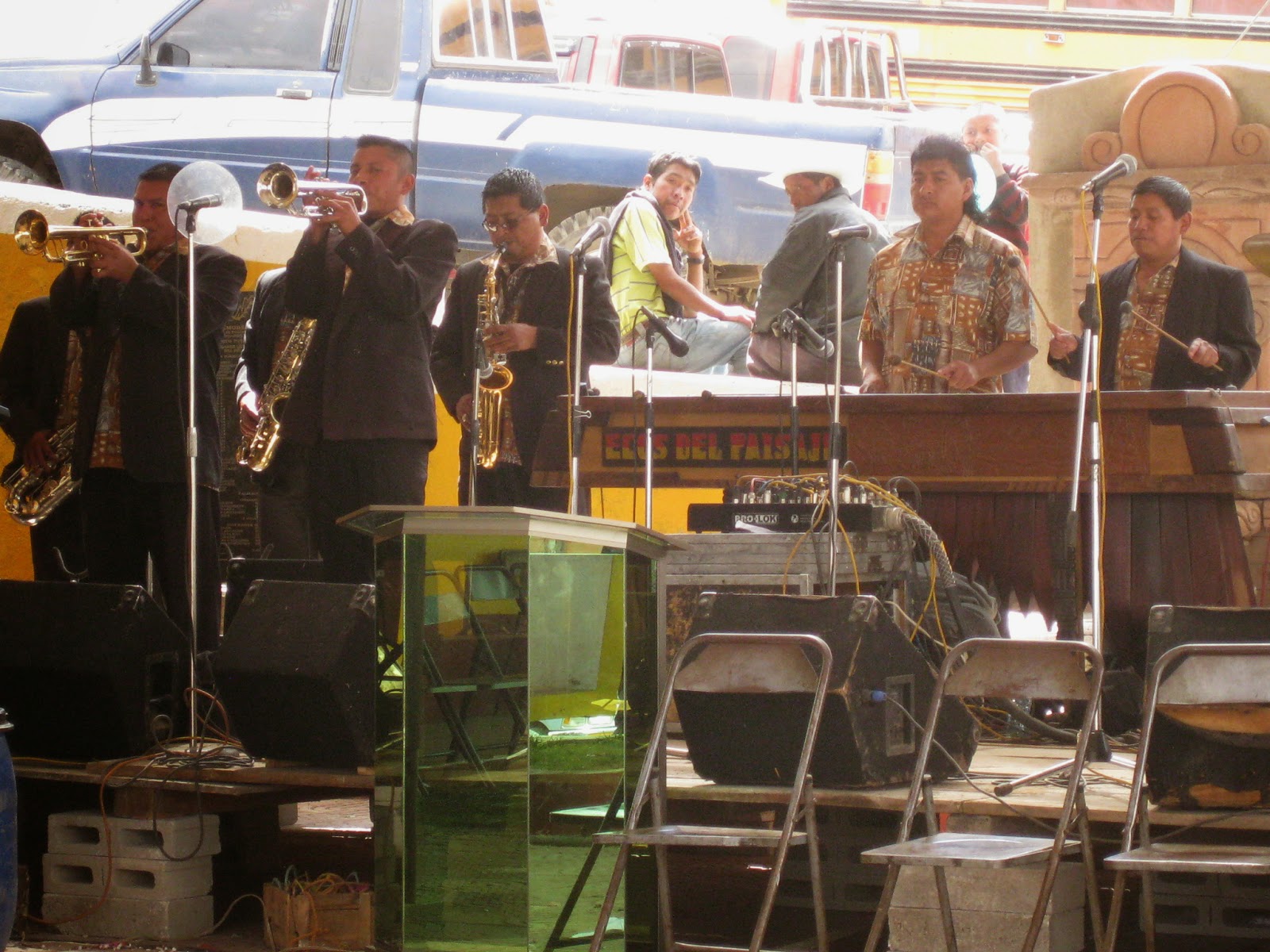
Naturally in true Guatemalan style my town had a big celebration for the first day of this second market. They set up a big stage in the main square where all morning they had loud live music playing and dance performances. 

Public restrooms - you pay this man a couple of quetzales and get a little bit
of toilet paper
Two women praying at a Mayan altar
Woman selling sugar cane on the street
Live Marimba and brass band

Then there were the dances. All of the performers were men dressed up in these elaborate costumes and women's masks. They didn't so much dance as sway from side to side as the dance/marched around in different formations. You really have to see it to understand it.


Shopping here takes longer than usual. The market in my town is open air and takes up the whole "downtown" area which is the equivalent of a very small U.S. block. None the less walking up and down the streets, stopping to ask prices, and bargaining takes time (although I would say that it is worth it). 

Thursday, June 19, 2014

Trash Management (or Lack Thereof)

There is no trash pick-up in my town so most families and schools burn their trash. All of their trash: paper, plastic, and organic. I personally separate my trash. I take my plastic trash into Xela when I go to do work or meet up with friends, I burn my paper trash in the plancha in my kitchen, and about once a week I feed my organic trash (aka food scraps) to the pigs. My host family has a lot of them and often times they can be found walking around the backyard and throughout the house. I don't have a sink and I have yet to see anything that looks like a garbage disposal anywhere in Guatemala so I store all of the scraps in a bucket and then whenever it gets full I take a little walk out back and give it all to the pigs. 

This is my kitchen when I am burning my paper trash. There is a chimney, but a lot of smoke escapes from the top nonetheless.


The to-be happy recipient of my organic trash

Monday, June 16, 2014

Election of the Madrina - Guatemala's Beauty Pageant for Teachers

Last week I went to the district-wide event in my town hall. A beauty pageant for teachers with four teachers competing. There was no school Friday so that all of the teachers could attend this event. It was on the hora Chapin (Guatemala-time). It was supposed to start at 8am, but when I got there at 8 there were only five people sitting in the audience. Finally at 9:15 they started with the national anthem, the anthem of Central America, the song Mi Linda Totonicapán (my beautiful Totonicapán), and a prayer. Finally at 10:00am the first contestant walked out. I should really know by now that late is on time.

Friday, June 13, 2014

Derrumbes (Landslides)

This word wasn't a part of my Spanish vocabulary before I came to Guatemala or even before I experienced a rainy season in Guatemala. It certainly is now. During the rainy season it rains almost every single day in the afternoon from May-December. It's not my favorite, although it is an excuse not to leave the house in the afternoon because Guatemalans don't like to go out in the rain either.

I have to pass by this to get from my town to Xela. Luckily they opened up a side path for cars so that traffic can pass by one way at a time. This probably adds about half an hour to my trip each way.

I wasn't able to snap a picture myself so I downloaded this one off the internet

I feel like if one were to pass by this in the U.S. one would think that a mini disaster had happened. Not here. Landslides are very common during the rainy season due to the poor infrastructure, overly saturated ground, and location of the roads. A lot of the roads are built right into the sides of mountains. I highly doubt this this will be the last time that my travel will be delayed due to landslides. That's just how it is here.  

Monday, June 9, 2014

I Think That I was Extra Hungry When I Went to the Market Today...

Total cost: $9.75 or 75.5 Quetzales

On the bright side, for less than $10 I bought: 30 eggs, cilantro, 1lb potatoes, cauliflour, 6 avocadoes, 6 red peppers, 3 cucumbers, 2 lbs tomatoes, a bag of carrots, a larger version of a zucchini, 2 heads of broccoli, a bunch of swiss chard, and 3 pineapples. A vegetarian's delight. I am not a vegetarian for the record. The only downside is that I then spent almost the entire afternoon disinfecting all of this in water and bleach. 

Also this happened:
$0.39 or 3 Quetzales worth of beet leaves

I saw that one of the venders had a lot of extra beet leaves laying around so I asked her if I could have them. Usually they just throw them away or leave them on the ground when they go home for the day. She said that she would sell me a bag for 3Q. Trying not to be stingy I agreed. Little did I know what size bag she was referring to. I'm not sure if you can tell exactly how big this bag is from the picture. It is about the same size as my entire torso. When she handed the bag I must have looked surprised because she offered to put more in the bag. I said thank you, but that wouldn't be necessary. I have NO idea how I am going to use all of these leaves in addition to the other vegetables that I bought before they go bad... My creativity and my stomach have its work cut out for it.